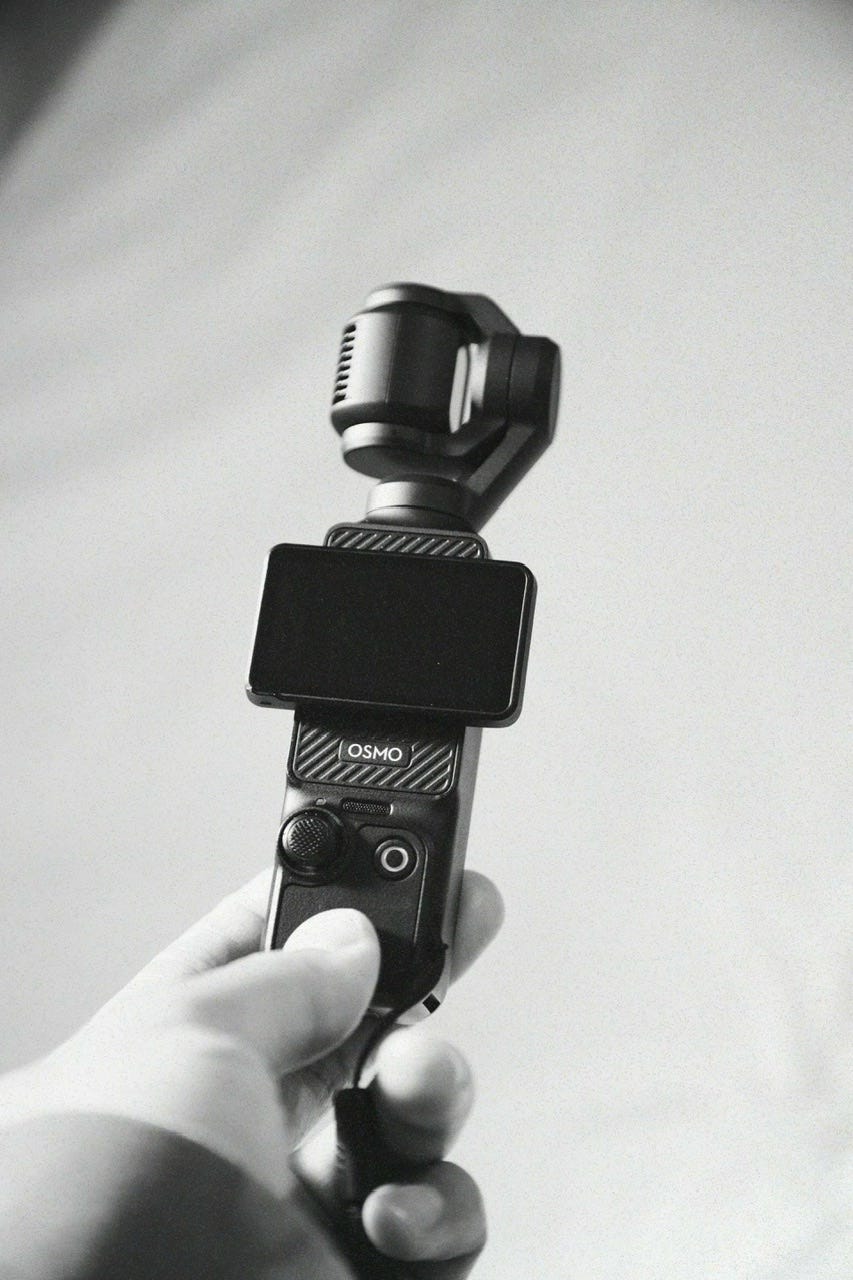
I am a photographer. I take STILL photos. But I’ve always loved cinema. The color grading, the composition, and the powerful stories moving pictures can tell leave me speechless. Movies and films are captivating and beautiful, and as someone who aims to create emotion with visual arts, I can’t help but want to try making videos.
The video capability of my iPhone 15 is stunning. I began making short TikToks (yes I know they’re not cinema) with my iPhone, and the power of short-form storytelling instantly captured me. An 1/8th of a second clip could convey so much, and when I thoughtfully compose a timeline, you can capture and share an entire evening in less than a minute.
I exercise restraint when purchasing photo equipment. Upgrading my mind before my equipment is a priceless investment that I’ll always choose. That’s why I chose to learn basic video creation skills with my iPhone. And when I felt confident that I was ready for something more, I chose the DJI Osmo Pocket 3.
YouTube is flooded with videos comparing the Osmo 3 to the iPhone 15. Which lead me to wonder if I really upgraded or just bought a similar product. After a month of constant use, I can confidently say the Osmo 3 was the right choice. Here are my five main reasons.
I. Ergonomics
The “pocket” aspect means everything
“The best camera is the one you have on you” is so cliche and so true. The Pocket 3 is minuscule, incognito, and un-intimidating. Holding the Pocket 3 is like holding air (it’s less than 200g). The way it fits into my palm feels like an extension of my body, and my creative mind. For the people around me, the camera largely goes unnoticed. The all-black body attracts zero attention, and the only time I get looks are when I use my body to pan, do pull-back shots, and film myself (mainly because they’re wondering what I’m looking at because it’s so unnoticeable).
There are very few situations where the Pocket 3 doesn’t work. I was surprised how quickly I learned the simple menu structure, and in less than an hour I was creating the shots I had in mind. I love when the camera gets out of the way and gives me the results I want, the Pocket 3 does that without much work.
I purchased my Pocket 3 with “Creator Combo”. It’s an accessory kit that adds a case, wide-angle conversion lens, wireless microphone, mini tripod, extra battery, and a few more items. These additional accessories elevate the Pocket 3 from a winner to a hero, and greatly expand what I can do with the camera.
The wireless mic and the tripod let me set the camera down and film myself while I’m doing an activity. For my crochet tutorials, cooking videos, and simple b-roll, the setup helps me create a clear picture of what I’m saying and doing. The battery grip extends my shooting time so I can film longer time lapses and make better voiced-over segments. I wouldn’t have the Pocket 3 without the creator combo, it turns the camera into a full-production powerhouse.
Pocket 3 + Creator Combo
II. Image Quality
The results are magic, let’s get nerdy
Sensor size matters. It’s just physics; bigger sensors collect more of everything. I shoot full-frame and I can discern crop-sensor footage from a mile away. Fight me. The Pocket 3 has a 1-inch type sensor. That makes the Pocket 3 substantially better than the smaller-sensor iPhone, right? In the case of the Pocket 3; absolutely. DJI did an excellent job mitigating the drawbacks of a larger sensor, while also harnessing the gains a larger sensor brings.
The low-light performance from the Pocket 3 is stunning. The footage is just clean. There are very few high-iso artifacts, false-colors, and intrusive image processing. The end result is nighttime video just looks good. Being able to shoot later into the day helped me find new opportunities to make interesting clips. Low-light is a whole new frontier for me to explore now!
The lens is also very capable! The Pocket 3 has an f2.0 aperture which smoothly separates the subject from the background. Think portrait mode on your phone, but this effect is done through the lens and sensor, not software trickery. The effect is great for showing food without seeing the whole restaurant behind the dish! The Pocket 3 renders subject vs background shots (read bokeh) in a way that felt leagues ahead of my iPhone.
The Pocket 3 makes great video. The camera shoots 4K/120FPS, 10bit D-LOG, and has a host of great settings to extract the maximum quality footage from whatever scene you’re working with. Even if you don’t change the default settings you’ll still get great footage, which is great news for people freshly learning “pro” features.
Quick startup means fewer missed shots
III. Gimbal Stabilization
Real moves
What separates the the Pocket 3 from the competition is arguably the camera’s greatest strength. The camera alone performs great, but adding a physical image-stabilization solution makes this cam a champ.
It’s challenging to get stable footage. My iPhone uses lots of tricks to keep the video smooth, it shifts the sensor around inside the phone and uses algorithms to go frame-by-frame to eliminate jitters. But at the end of the day, the iPhone is held by my shaky hands and no amount software can compensate for that.
That’s where the Pocket 3 pulls ahead. Between the camera and the handle (the part you hold) there’s a gimbal. It’s a motorized mechanism that rotates the camera opposite of what my hands are doing. This means the camera remains level regardless of what I’m doing. When I’m walking, running, or skiing the gimbal is always working to smooth out the bumps and jitters. The results make the camera looks as if it’s flying through space and untethered from the ground. It’s wild.
The Pocket 3’s gimbal does more than stabilize footage. My favorite feature is called ActiveTrack, which uses the gimbal to keep the camera pointed at me. If I walk outside the frame, the camera will simply rotate to keep up. It’s like having your own filming assistant to keep you in the middle of the frame! I also like using HyperLapse, a tool for combining time-lapses with panning. HyperLapse helps add gradual movement to the time lapse and makes b-roll pop.
The gimbal in action
IV. The Sum of The Parts and Unbeatable Value
Moving beyond my iPhone’s video capabilities
Just because the Pocket 3 makes pretty footage and is a full-spectrum content creation powerhouse doesn’t make it the best camera for everyone. Luckily for my needs the Pocket 3 was the perfect purchase. I bought the Pocket 3 because I wanted to improve the quality of the footage I was already making. The quality of my pans, pull-back shots, and walking footage are incredible. And with the features brought by the gimbal, I can now film myself doing complex moves and make excellent b-roll.
My use-case for the Pocket 3 probably aligns with vlogger / influencer needs more than the cinematographer’s needs. I’m most pleased with the Pocket 3 when I’m documenting what it’s like exploring a new city, trying new foods, and making “a day in the life” type videos. That’s not to say that the Pocket 3 can’t produce aesthetic footage; I can absolutely grade the D-LOG 10bit footage into something beautiful.
But if you’re spending money to chase aesthetics, perhaps a used Panasonic GH4, Metabones Speedbooster, and some vintage glass would be a better investment. Or if you’re just trying to film yourself while biking and running, a waterproof and rugged GoPro would serve you better. The Pocket 3 is unique because it incorporates the competition’s best features into one product. The Pocket 3 is small and portable like a GoPro, but it’s a 1-inch sensor outperforms some of its larger-bodied competitors from Sony, Canon, and Panasonic. The Pocket 3 is uniquely positioned because its competition is either larger, more expensive, or less performant. That’s where the Pocket 3’s value shines, the mic is indispensable for the vloggers, the gimbal is a godsend for the action-cam crowd, and f2.0 lens and 1-inch sensor with 10bit LOG footage will keep cinematographers happy. For the price nothing compares to the Pocket 3.
Functional accessories expand the Pocket 3's versatility
V. The Little Things
USB-C FAST CHARGING
It recharges to 80% in like 15 minutes, that’s great when traveling.
USB-C PD fast-charging is appreciated during long travel days
CREATOR COMBO CASE MAKES CARRYING EVERYTHING A CINCH
The cleverly designed case holds all the accessories securely, and makes this a go-anywhere setup.
SIMPLE MENU STRUCTURE
Three taps or less, that's all it takes to find what I'm looking for. DJI's menu layout is easy and fast. There are very few menus with sub-menus, and the icons are well sized for large finger. Compared to my Sony ZV-1F, which has about 80,000,000 menus upon sub-menus, the Pocket 3 is simple.
Finding features and changing settings are straightforward
MAGNETIC FILTER SYSTEM
The first lesson I learned in filmmaking was the 180 degree shutter rule. The Pocket 3 cleverly uses magnets to mount a filter versus the traditional threaded filter ring. This solution is fast and compact and shows that DJI considers what pros want.
Swap ND, UV, and Black Mist filters with a magnetic snap
NO-FLAP MICROSD SLOT
Another "we listen to our customers" feature: the MicroSD card slot has no cover and getting your card out is a simple thumb-press. Thank you!
PLASTIC IS BETTER THAN METAL
The plastic body is lightweight, scratch resistant, grippy, and helps dissipate heat. I thought plastic equaled cheap, but DJI's build quality is top-notch and probably a better choice for this camera.